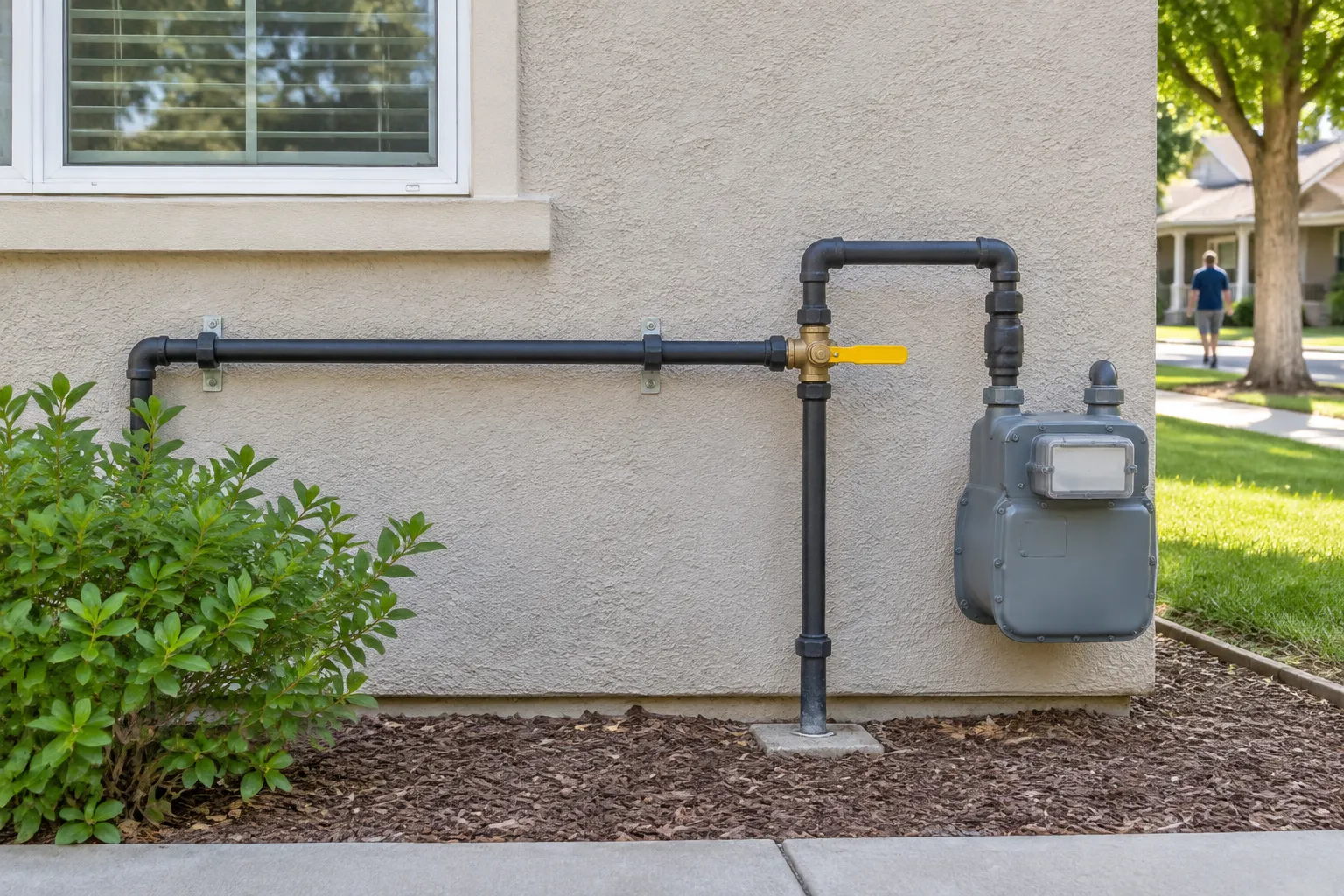
Fixr's plumber cost guide (updated January 2025) lists $500 to $2,000 to install a gas line, and Fixr's gas line repair guide (updated August 2025) says all-new gas lines in a house cost $3,000 to $8,000. Adding a short line for a stove, dryer or water heater sits at the low end. Running a new line to a grill, fire pit or detached building, especially underground, is at the high end. Sacramento prices vary. The specialist you hire quotes the real price.
Gas work carries a legal line. A gas line is not a DIY job in California. Read the gas line installation guide for how the work runs and the safety rules, then use this page for the money. You can get quotes from local specialists on the quote page.
How much does gas line installation cost?
Fixr lists $500 to $2,000 for a gas line installation and $3,000 to $8,000 for all-new gas lines in a house. The price depends on how far the pipe runs, whether it is indoors or buried, the pipe material, the permit and the work needed to connect the appliance.
| Job | Typical range |
|---|---|
| Gas line installation | $500 to $2,000 (Fixr plumber guide) |
| All-new gas lines in a house | $3,000 to $8,000 for all-new gas lines in a house (Fixr gas line guide) |
| Gas leak repair or pipe section replacement | $150 to $700, average $400 (Fixr gas line guide) |
| Gas pressure test and inspection | $75 to $100 for a pressure test, $50 to $75 for an inspection (Fixr) |
| Permit | Varies by city and scope |
These figures come from Fixr's plumber cost guide (updated January 2025) and Fixr's gas line repair guide (updated August 2025). They differ by the exact job, and Sacramento prices vary.
What is the gas line installation cost per foot?
Fixr's gas line repair guide lists $23 to $35 per linear foot to replace a gas line, including removal of the existing line, and $15 to $35 per linear foot for repair by pipe material. Short runs often come with a minimum charge, which is why a 10 foot job can cost nearly as much as a 25 foot job.
Quotes often combine a base fee for the visit, permit and connection with a per-foot rate for the pipe. The per-foot figure is only part of the picture. A cost calculator can give a ballpark, but it cannot see whether the pipe must go through a finished wall, under a slab or around a tree.
Common pipe types in homes are black iron pipe, corrugated stainless steel tubing (CSST) and, underground, polyethylene (PE) pipe. The plumber chooses based on code, location and the pressure of the supply. Which one fits depends on your house and the local rules, so do not shop by material.
How much does a natural gas line cost compared with propane?
A natural gas line runs about the same as a propane line for the piping inside the house, but propane has a different setup. Natural gas comes from the utility's main. Propane comes from a tank on your property, and a propane tank installation adds a separate cost, depending on whether you lease or buy the tank and how it is placed.
In Sacramento, natural gas service comes from PG&E. A new house connection or a new meter is arranged with PG&E. The cost of a new service connection varies widely, so ask PG&E for an estimate for your address. PG&E also publishes average cost and timeline estimates for typical residential service connections.
Propane is used in properties without gas service. The same rules about installers with the right license, permits and pressure testing apply. Propane lines have different regulators and sizing, so the installer has to be set up for propane work.
The cost of a gas line also differs from other utilities you may have seen quoted elsewhere. Pages that mention other states' gas companies describe their own rules and fees, which do not apply in Sacramento.
Who is allowed to install a gas line in California?
California requires a plumbing contractor with a California license (C-36) for jobs of $1,000 or more in labor and materials, and for any work that needs a permit, according to the Contractors State License Board. Gas piping work normally needs a permit and an inspection. Do not install or alter gas piping yourself, and do not hire an unlicensed handyman for it.
The City of Sacramento's permit page for a residential new gas line says its permit covers the onsite work, and that tap work involves PG&E. PG&E is visited typically after the permit for the onsite work is pulled. For the exact permit your job needs, check with the City's permit staff or the Public Permit Portal. The plumber you hire should know the process and pull the permit.
Reasons the rules are strict: a poorly joined gas pipe can leak, and gas leaks cause fires, explosions and carbon monoxide risks. A pressure test and an inspection are how the work is checked before it is covered up and used.
If you smell gas, leave the house, do not turn electric switches on or off, avoid flames, and call 911 and PG&E from a safe distance. Do not try to find the leak yourself.
What pushes the price of a gas line up or down?
Seven things matter most: distance, route, depth, pipe type, number of appliances, permits and access. A short line to a stove in an open basement or crawl space is simple. A line through finished walls, under a slab or across a yard costs far more because of the cutting, trenching and repair work.
- Distance from the meter or existing gas line. Longer runs cost more in pipe and labor.
- Route. Open access is cheap. Finished walls, concrete and tile are not.
- Underground or above ground. Trenching adds labor and, under driveways or patios, cutting and repair.
- Pipe size. If total gas demand rises, the main line may need to be larger. A plumber sizes the pipe by the load of all appliances.
- Number of outlets. A line with a stub for a future grill is cheaper to add now than later.
- Appliance connection. Flex connectors, shutoff valves and sediment traps are small parts but add up.
- Permit and inspection. Fees vary by city and scope.
- Meter upgrades. If the current meter cannot supply the new load, PG&E must be involved and the cost is separate.
Adding a gas line for a stove costs more if the kitchen is being remodeled and the walls are closed. A gas line for stove installation is quoted as part of the appliance hookup in many remodels, so ask whether the price covers the pipe, shutoff and connector.
How do you compare gas line quotes?
Compare quotes on scope: pipe length and type, route, permit, pressure test, appliance connection and wall or yard repair. A quote that lists only a total is hard to compare. Ask each plumber to list what is included and who pulls the permit. A low price from someone who plans to skip the permit is not a deal.
Before you hire, confirm the contractor's license number on the state board's website, and ask for proof of insurance. Ask who contacts PG&E if a new service line or meter is needed, and how long that part takes, since the utility schedule is outside the plumber's control. For general rates, see the plumber cost guide. If your project involves a gas water heater, the guide to tankless water heater installation explains the gas line sizing that often comes with it. The Sactown Plumbing Guide home page lists other topics.
Questions people ask
How long does gas line installation take?
A short indoor line for a stove or dryer typically takes a few hours to a day, including the pressure test. A longer underground run can take one to three days, plus time for the permit and inspection. If PG&E must add or change a service line or meter, that part runs on the utility's schedule, which can take weeks.
What should I ask before I hire someone for gas line installation?
Ask for a written scope and price, the contractor's license number, who pulls the permit, whether the price includes a pressure test and inspection, and how wall or yard repair is handled. Ask what happens if the inspector finds a problem. Also ask whether PG&E is involved and who coordinates it.
Do I need to be home for gas line installation?
Yes, an adult should be there at the start to confirm the route and appliance locations, and again when the plumber tests the line and relights or checks appliances. Gas is shut off to part or all of the house during the work, so plan around cooking and heating. Inspections may need access too.
Can I install a gas line myself?
California law and the permit system treat gas piping as regulated work, and a gas line normally needs a permit and an inspection. A mistake can cause a leak, fire or carbon monoxide. Hire a plumbing contractor with a California license, and check the permit rules with the City of Sacramento or the county for your address.
Sources used
- Cost to Hire a Plumber, Fixr (updated January 2025)
- Gas Line Repair Cost, Fixr (updated August 2025)
- City of Sacramento, residential installation of new gas line
- PG&E, residential project resources for new gas service
- California Contractors State License Board, licensing rules for work of $1,000 or more
Last changed