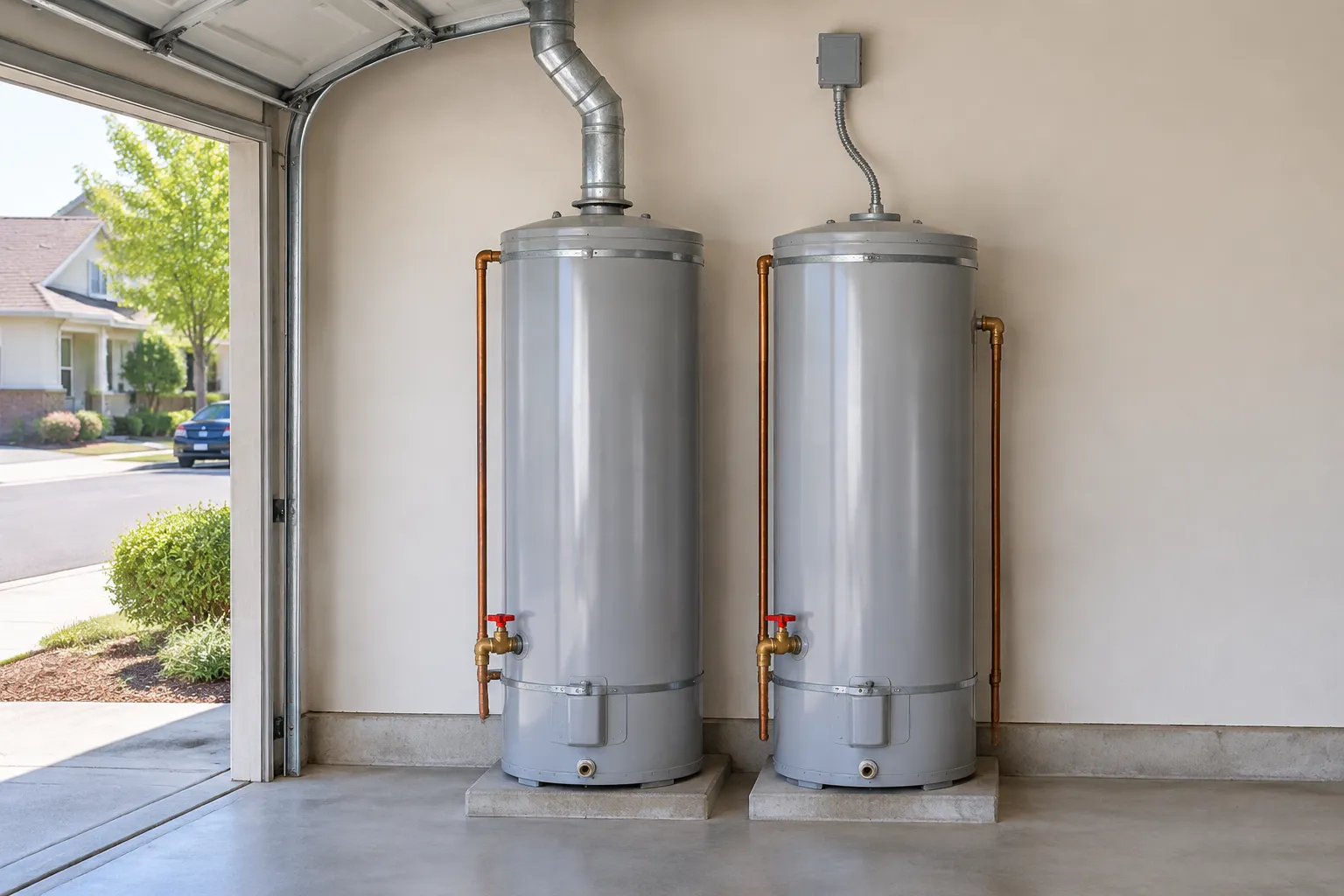
For most Sacramento homes, the deciding question is what you already have. A gas tank swapped for a gas tank is the cheapest and fastest job. A switch to electric avoids a gas line and vent but needs a 240 volt circuit. A heat pump water heater costs more up front and uses far less electricity than a standard electric tank.
This page is part of the water heater repair and replacement guide. It compares installed cost, running cost, efficiency, safety and the practical work of changing fuels, so you can ask local specialists for the right quote.
How do electric and gas water heaters compare on cost?
This Old House's water heater cost guide (updated June 2026) lists $1,200 to $2,300 for an installed tank water heater and $2,500 to $3,500 for a heat pump model. Fixr's 40-gallon guide (updated January 2026) gives $700 to $1,650 installed for an electric tank and $700 to $2,300 for gas or propane. Size, brand, venting, permit fees and any code upgrades move the price. Sacramento prices vary, and the plumber quotes your real figure.
| Type (40 to 50 gallon) | Typical installed cost | Main cost drivers |
|---|---|---|
| Natural gas tank | $700 to $2,300 for 40 gallons (Fixr) | Venting, gas line, flexible connector, relocation |
| Electric tank | $700 to $1,650 for 40 gallons (Fixr) | Circuit and breaker condition, access |
| Heat pump electric | $2,500 to $3,500 (This Old House) | Space and airflow, condensate drain, a circuit |
| Propane tank | $700 to $2,300 for 40 gallons (Fixr) | Propane supply and regulator |
Running cost is the other half. Gas generally costs less to heat the same water, but the gap depends on current PG&E gas rates against SMUD electricity rates for your home. Rates change, so ask each utility for the current price per therm and per kilowatt hour and run the numbers for a household of your size. A heat pump unit, which moves heat rather than making it, often cuts the electricity used by a standard electric tank by well over half.
Is it better to repair or replace a water heater?
Repair a heater that is under about 8 to 10 years old when the fault is a part such as a thermostat, element, igniter or valve. Replace one that leaks from the tank body, is past 10 to 15 years or needs a repair costing more than about half the price of a new unit. Fuel choice comes up at the moment you replace.
Replacement is the moment to decide whether to stay with gas, move to electric or step up to a heat pump. Repairs do not change fuel. If your tank is failing, our page on water heater replacement cost lists what new units cost, and how long a water heater lasts helps you judge whether to spend on a repair at all.
What is the best water heater on the market today?
There is no single best model. The right one is the one sized for your household, matched to the fuel you have and backed by a plumber who can service it. Compare the first-hour rating for capacity, the uniform energy factor for efficiency, the warranty length and how easily local plumbers can get parts for the brand.
Widely sold tank brands include A. O. Smith, Rheem, Bradford White and State. A 40 gallon tank is often enough for two or three people and a 50 gallon tank for a three or four person household, though a soaking tub or heavy laundry use may call for more. See our page on the 50 gallon electric water heater and the 40 gallon gas water heater for the two most common sizes.
Which is more efficient, gas or electric?
On paper, a standard electric tank converts nearly all of its input electricity to heat, so its efficiency rating is higher than a gas tank, whose burner loses heat up the flue. Heat pump water heaters are the most efficient of all, with ratings several times higher. But efficiency is not cost: gas energy is often cheaper per unit of heat than grid electricity.
So the efficient choice and the cheapest choice can differ. A heat pump water heater usually wins on total running cost for an all-electric home. A gas tank usually wins on running cost where gas is already piped in and a heat pump is not practical. Gas tankless units raise efficiency further but cost more to install, as the tank vs tankless comparison explains.
Heat pump units need open space and airflow around them, and they cool the room slightly, which is a benefit in a hot Sacramento garage. They also give off a cool, damp output that needs a condensate drain. Check the current SMUD and state rebate programs on their official sites before buying, because incentives change.
Is an electric water heater safe?
Yes, when it is installed to code on a correctly sized circuit with a working temperature and pressure relief valve. An electric tank has no flame or combustion gases, so there is no carbon monoxide or gas leak risk from the heater. The main hazards are scalding if the thermostat is set too high and a failed relief valve.
Set the thermostat to about 120 degrees Fahrenheit, which reduces scald risk and saves energy. Do not open the panel or touch wiring with the power on. Wiring faults belong to a plumber or electrician, depending on the fault. Our page on the electric water heater covers the safety checks, sizes and costs in more detail.
Gas heaters are also safe when installed correctly (the Sactown Plumbing Guide home page lists other topics), but combustion brings extra requirements: proper venting to the outdoors, combustion air and a gas shutoff valve. Ask your plumber what carbon monoxide alarm rules apply to your home. California law requires residential water heaters to be braced against earthquakes, gas or electric. In a garage, the California Plumbing Code also requires gas burners and ignition devices to sit at least 18 inches above the floor unless the heater is a listed flammable vapor ignition resistant model.
What does it take to switch from gas to electric?
Switching needs a dedicated 240 volt circuit with the right breaker, usually 30 amps for a standard electric tank, a connection to the electrical panel and capping or removal of the gas line and vent. If the panel is full or undersized, an electrician may need to upgrade it. A heat pump unit also needs a drain and clear airflow.
Total cost varies widely. A short run from a nearby panel is inexpensive, while a long run, a panel upgrade or a drywall repair adds cost. The plumber should handle capping the gas connection safely. In Sacramento the permit covers the plumbing and often the electrical work, so ask who pulls it. For the general sequence of a replacement, read about choosing a plumber for water heater replacement.
Going the other way, from electric to gas, is a bigger job: a gas line, a vent through the roof or wall and combustion air. Not every house can host it. Ask the plumber and the city permit office what applies to your address.
What if your gas water heater pilot light will not stay lit?
A pilot light that will not light or keeps going out is usually caused by a worn thermocouple, a dirty pilot tube, a draft or a failing gas control valve. You can try the relighting steps printed on the tank label, but if it fails after a couple of attempts, stop and call a plumber. Gas parts are work for a plumbing contractor, not a home project.
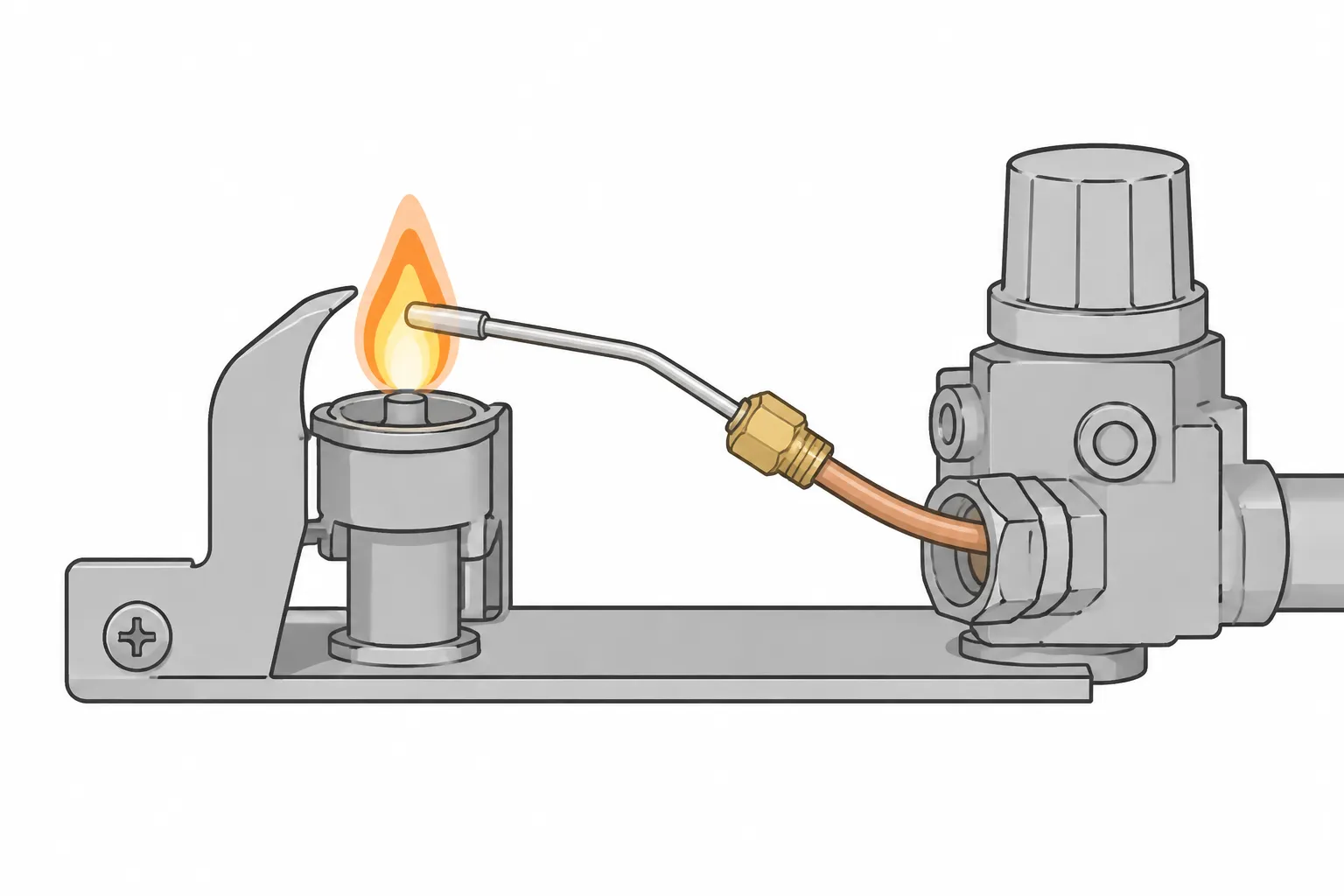
Newer gas tanks often use an electronic igniter instead of a standing pilot, and these show an error light or code that the manual explains. If you smell gas at any point, leave the house and call 911 and the gas utility from outside. For other no-hot-water causes, see no hot water.
Propane heaters work the same way as natural gas ones but use a different orifice and supply. They are less common in the city of Sacramento and more common on rural properties, where propane is delivered to a tank outside.
Questions people ask
How long does water heater electric vs gas take?
Most tank-for-tank replacements, gas or electric, take about two to four hours. Switching fuel takes longer, often a full day, because of the new circuit or the gas capping and venting changes. A permit inspection may be scheduled on a separate day. Ask the plumber for the full timeline, not just the install time.
What should I ask before I hire someone for water heater electric vs gas?
Ask what the price includes: the permit, seismic straps, a new relief valve and discharge pipe, an expansion tank if needed, a gas connector, disposal of the old tank and any panel or venting work. Ask for the license number and check it with the California Contractors State License Board. Ask what warranty covers the labor.
Do I need to be home for water heater electric vs gas?
Usually yes, at least for the start and the end of the job. The plumber needs access, will shut off water and power or gas, and will want you to approve the final price. You will also want to see the new unit tested and be shown the shutoff valves. An adult you trust can stand in for you.
Sources used
Last changed