What you will find here
Sactown Plumbing Guide is an information site about plumbing in Sacramento. It explains what common jobs involve, what they tend to cost, which ones the law reserves for a contractor with the right California license, and how to ask local specialists for quotes. It is run by Sactown Plumbing Guide.
The pages are written for homeowners, landlords and renters who have a plumbing problem and want to understand it before they pick up the phone. Each guide covers one question: a dripping water heater, a slow sewer line, a toilet that keeps running, a repipe. You get the likely causes, the typical price range and what pushes it up or down, and a clear line between what you can look at yourself and what needs a professional.
If you want a figure for your own job, start with the plumber cost guide, then read the guide for your specific problem. The full list is on the guides page. When you are ready for numbers from real businesses, the quote form takes about two minutes.
What happens, step by step
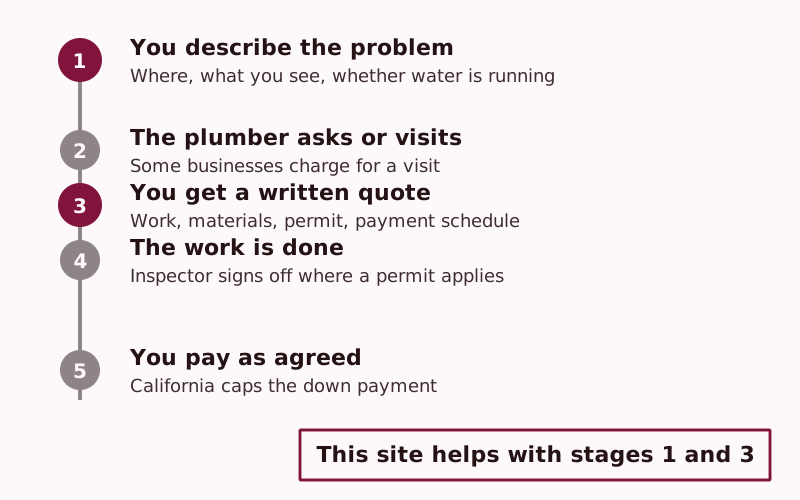
A plumbing job in Sacramento usually runs in five stages: you describe the problem, a plumber asks questions or visits, you get a written quote, the work is done (with a permit and inspection where the job needs one), and you pay against the agreed schedule. This site helps with the first and third stages.
Here is how that looks in practice.
- You describe the problem. Where the fixture is, what you see or hear, how long it has been happening, and whether water is still running.
- The plumber asks questions or visits. Simple jobs can be priced from a description and photos. Sewer, gas and hidden-leak work usually needs a look first, and some businesses charge for that visit.
- You get a written quote. It should name the work, the materials, who pulls any permit, and the payment schedule.
- The work is done. For anything that needs a permit, a city or county inspector signs it off afterward.
- You pay as agreed. California caps the down payment on a home improvement contract. More on that below.
You can read the longer version on how a job runs.
What the regulations say
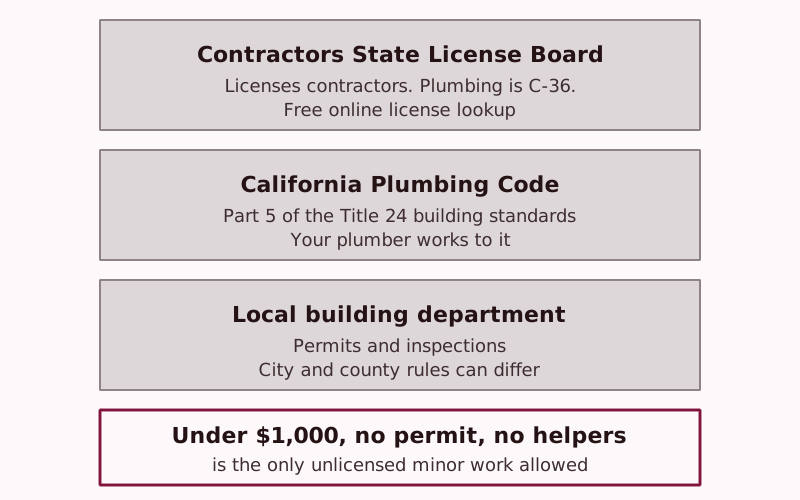
Plumbing in California is regulated by the state. The Contractors State License Board (CSLB) licenses contractors, and the plumbing classification is C-36. The work itself must follow the California Plumbing Code, which is Part 5 of the state's Title 24 building standards. Permits and inspections come from your local building department.
The details that matter most to a homeowner:
- The C-36 classification. CSLB describes a plumbing contractor as the trade that supplies safe water and disposes of fluid waste in structures. Its scope includes drain, waste and vent piping, water piping, gas piping and appliance connections, and water heating equipment.
- The $1,000 rule. Since January 1, 2025, a person without a contractor license may only take minor work totaling less than $1,000 in labor, materials and everything else. Even then, the work cannot need a permit and the person cannot hire any helpers. Otherwise California requires a contractor with the right California license. CSLB states this in its Industry Bulletin 24-07.
- Check the license first. CSLB runs an online lookup where you can search by license number or business name and see the status of the license and any complaint disclosure.
- The contract. CSLB's consumer guidance says a home improvement contract should list the contractor's license number, who is responsible for permits, the work and materials in detail, and a payment schedule. The legal down payment is $1,000 or 10 percent of the contract price, whichever is less, unless the contractor has a blanket performance and payment bond on file with CSLB.
- The code. The California Plumbing Code is published by the International Association of Plumbing and Mechanical Officials as part of Title 24 and adopted through the California Building Standards Commission. Your plumber works to it. You do not need to read it.
The rules change. Always confirm the current version on cslb.ca.gov and with the building department that covers your address.
What you will not find here
This site does not do plumbing work, does not employ plumbers and does not carry out repairs. It does not rate or rank businesses, and it does not publish reviews, star scores or testimonials, because it has none to show and will not make any up.
Nothing on these pages is a license number, an endorsement or a claim about any particular business. If a page names a price, it names the cost guide it comes from, such as Fixr or This Old House, and the plumber who visits sets the real price. We do not sell your details to advertisers, and the privacy policy explains what happens to what you send.
The guides are general information. They are not legal, safety or engineering advice for your house. Gas smells, sewage backing up into the home, a failed water heater relief valve and flooding all call for a professional, and sometimes for the utility or emergency services first.
Areas covered
The guides cover Sacramento and the surrounding neighborhoods and nearby communities, including Midtown, East Sacramento, Land Park, Natomas, Oak Park and Pocket-Greenhaven, plus Arden-Arcade, Carmichael, Citrus Heights and West Sacramento. The areas page lists each one with notes on its housing and plumbing.
Where your home sits matters for the rules. The City of Sacramento, Sacramento County and neighboring cities each run their own building departments, so permit steps and fees can differ. Find out which one covers your address before you plan a job that needs a permit. Prices in the guides are Sacramento-area ranges, not quotes, and local specialists confirm the figure for your house. The home page is a good starting point if you are not sure where to begin.
Questions people ask
Is Sactown Plumbing Guide a plumbing business?
No. It is an information site. It does not do plumbing work, hold a contractor license or employ plumbers. Local specialists who do the work are independent businesses. This site explains the job, the typical prices and the rules, and gives you a way to ask for quotes.
Who checks the information on Sactown Plumbing Guide?
Legal and licensing facts are taken from official pages such as the Contractors State License Board, and each page lists the sources it used. Prices are ranges from the cost guides each page names, not quotes. Where a fact could not be confirmed, the page says "typically" or leaves it out. Tell us about an error at s29marketinginfo@gmail.com.
How do you make money?
Some local businesses pay a fee for the requests that are passed on to them. Reading the guides costs nothing, and sending a request costs you nothing. The fee does not decide what the guides say, and you pick who to hire, or nobody. The how-a-job-runs page explains the arrangement in full.
Do I need a plumber with a California license for a small job in Sacramento?
Often yes. In California, work under $1,000 in total can be done without a contractor license only if it needs no permit and no helpers are hired. Water heater, gas and sewer work usually involves a permit, so it generally needs a plumbing contractor with a California license. Check any contractor's license at cslb.ca.gov before you agree to anything.
Sources used
Last changed