A water softener installation plumber connects a softener to your home's main water line, runs a drain for the regeneration water, sets up a bypass and power, and tests the system. Fixr's water softener guide lists installation labor at $150 to $1,000 and a whole-house installation at $1,100 to $3,000, depending on the system and the piping. If the main question is price, see the water softener installation cost page. This page covers who does the work, what it involves and what to check first.
What does a water softener installation plumber do?
The plumber picks the location, cuts into the main water line, fits the bypass valve and connections, runs a drain line for the system's wash water, plugs in power, loads the salt and programs the control head. Then they test for leaks and set the hardness level for your water.
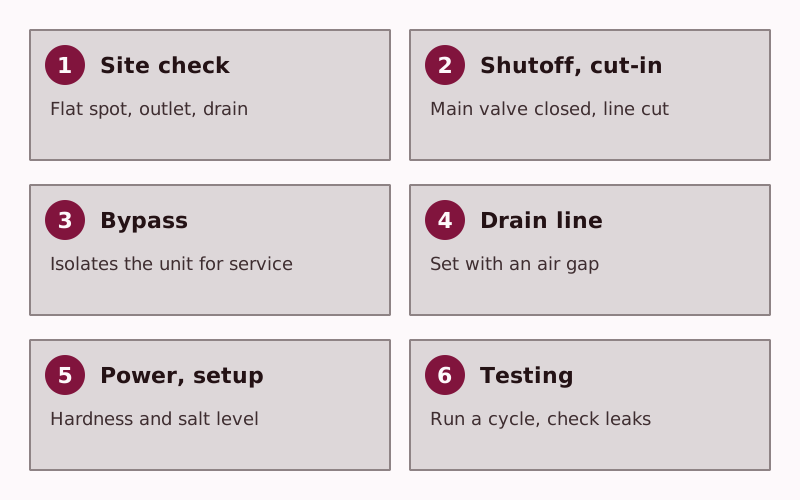
The usual sequence:
- Site check. The unit needs a flat spot near the main line, a nearby outlet and a drain: a floor drain, a standpipe or a laundry tub. Garages and utility closets are common.
- Shutoff and cut-in. The plumber closes the main valve and cuts into the line after the meter and any outdoor spigot branches, so outdoor taps stay on untreated water.
- Bypass and connections. A three-valve bypass or built-in bypass lets you isolate the unit for service without losing water to the house. Fittings are copper, PEX or flexible connectors, depending on the home.
- Drain line. The softener sends brine and rinse water to a drain. The plumber sets it with an air gap so wastewater cannot siphon back into the unit. Plumbing codes generally call for this gap, so ask the plumber to confirm it.
- Power and setup. The control head plugs into an outlet. The plumber programs hardness, regeneration time and salt level.
- Testing. They run a regeneration cycle, check for leaks and test the treated water.
Brand names come up in searches, including Culligan, Aquasana, Whirlpool and RainSoft. The installation steps are similar for any brand with a standard bypass and drain. Some brands sell through dealers who install the unit, and others sell at retail, where you hire a plumber for the install. Compare the install quote with the equipment quote, because the two are often priced separately.
Do you have hard water in Sacramento?
Sacramento's water is often in the moderately hard range, and it can differ by the source and the neighborhood. The City of Sacramento's 2025 Consumer Confidence Report lists a system average hardness of 83 mg/L, about 4.9 grains per gallon, for 2023 to 2025, with a wider range across its river and groundwater sources. Figures vary by year, source and area. Check your own water before you buy a softener.
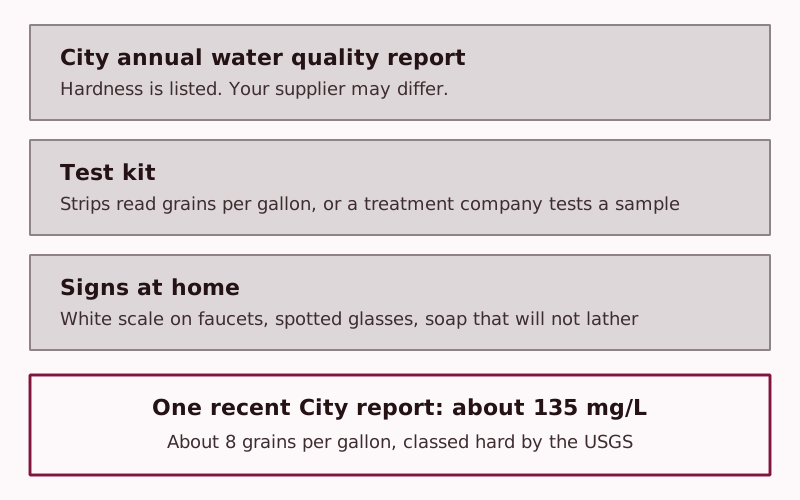
Ways to check:
- The city's annual water quality report. The City of Sacramento publishes a Consumer Confidence Report each year with hardness listed. Your supplier may differ if you are served by a different water agency or a well.
- A test kit. Hardware stores sell strips that read hardness in grains per gallon. A treatment company can also test a sample.
- Signs at home. Hard water shows up as white scale on faucets and showerheads, spots on glassware, scale in kettles and soap that does not lather well. It can shorten the life of a water heater by building scale inside the tank. See how to flush a water heater for what that looks like.
Hard water is not a health problem for most people. It is an appliance and cleaning problem. If your water is in the low range, a softener may not be worth buying. If it is high and you have spotting, scale and a short-lived water heater, the case is stronger.
What affects the price of water softener installation?
Fixr's water softener installation guide (updated January 2025) lists installation labor at $150 to $1,000 and the complete job at $1,100 to $3,000, with an average of $2,500, because the unit is the biggest line. Larger or dealer-supplied units cost more. Sacramento prices vary, and the plumber quotes the real number.
| Item | Typical range |
|---|---|
| Plumber labor, standard install with accessible main | $150 to $1,000 (Fixr) |
| Salt-based softener unit, residential | $650 to $3,000 installed for ion exchange (Fixr) |
| Salt-free conditioner (installation similar, different result) | $350 to $2,450 installed (Fixr) |
What moves the cost:
- Where the main line is. A main in an unfinished garage is quick. A main behind a finished wall is not.
- Pipe size and material. Galvanized steel can be hard to cut into and may need replacing. See PEX versus copper if the piping is being updated.
- The drain. A nearby floor drain keeps it cheap. If there is none, the plumber has to build a standpipe or run a line.
- Electrical. If there is no outlet nearby, an electrician adds one.
- A permit. Many plumbing alterations need a permit from the City or County building department. Ask who pulls it and whether it is in the quote.
If the plumber is also changing the water heater, ask them to quote both together. See water heater replacement cost for the ranges.
Signs you need a water softener installed
You may need a softener when you see white scale on fixtures, cloudy glassware, spotted dishes, dry skin after showers, a water heater that is failing early or scale in the kettle. These are signs of hard water, but a test of your own water tells you how hard it is before you spend money.
Before you commit, think through:
- Is it actually hard? A hardness reading under about 3 grains per gallon often does not need a softener.
- Do you want salt or no salt? Salt-based softeners swap calcium and magnesium for sodium or potassium and remove scale. Salt-free conditioners change how scale forms, but do not remove hardness.
- Check local rules. California law lets certain local sewer agencies, under set conditions, prohibit new residential self-regenerating softeners, which discharge brine into the sewer. Before you buy, ask your water supplier and the building department whether any restriction applies to your address. If you are on a private well and septic system, the questions are different, so ask the plumber.
- Water use at home. A larger household needs a larger tank. An undersized unit regenerates often and wastes salt.
Who is allowed to install a water softener?
A plumbing contractor holding a California C-36 license is the usual choice. California requires a contractor license for work of $1,000 or more in labor and materials, and any work that needs a building permit needs a license regardless of price. Dealers who sell and install their own units may use their own staff, so ask for the license number of the business doing the work.
You can look up any license on the state board's website. Check the status and the classification. Also ask:
- Is the permit included in the quote, and who is responsible for it?
- Will you install a bypass and an air gap?
- Where does the drain go, and what is the cost if the drain needs work?
- What does the warranty cover, parts only or labor too?
- Who services the unit afterward?
DIY installation is possible for an experienced owner with flexible connectors and a nearby drain, but mistakes at the main line can flood a garage. A plumber also knows what the code requires for the drain.
Questions people ask
How long does water softener installation take?
Most installations take two to four hours. A simple one with an accessible main and a nearby drain can be done faster. Longer runs, a new drain or galvanized pipe add time. The plumber should give you a window once they see the site.
What should I ask before I hire someone for water softener installation?
Ask what the quote covers: unit, labor, drain work, permit and first load of salt. Ask for a license number and the price in writing. Ask about local brine rules and whether the unit is a self-regenerating type, and what service and parts coverage you get.
Do I need to be home for water softener installation?
Yes, in most cases. The plumber needs to shut off the water and may need access to the garage, utility room and drain. You will also want to approve the position of the unit. If you cannot be there, agree access and the quote in writing beforehand.
Where is the best place to install a water softener?
Near the main line where it enters the house, after the meter and any outdoor taps, on a level surface with power and a drain. Garages and utility rooms work well. Protect it from freezing and direct sun, and leave room to add salt.
Can a softener damage my plumbing?
Softened water is not harmful to pipes. Some homeowners dislike the slippery feel and may leave the kitchen cold tap on untreated water for drinking. Installation mistakes, such as a leaking connection or a poor drain, are the real risk, so the install quality matters.
Should I fit a showerhead filter instead?
A showerhead filter may filter some chemicals at the shower but does not soften water throughout the house. It will not stop scale on fixtures or protect the water heater. It is a cheaper way to test whether a change helps skin and hair before you spend more.
Read on
- Water softener cost
What a water softener and its installation cost in Sacramento: equipment and labor ranges, loop installs, salt-free options, and when you…
More services are listed on plumber sacramento.
Sources used
- City of Sacramento Department of Utilities, Consumer Confidence Report (water quality)
- California Water Code, section 13148 (local rules on residential self-regenerating water softeners)
- California Contractors State License Board, licensing requirements
- Water Softener Installation Cost, Fixr (updated January 2025)
Last changed