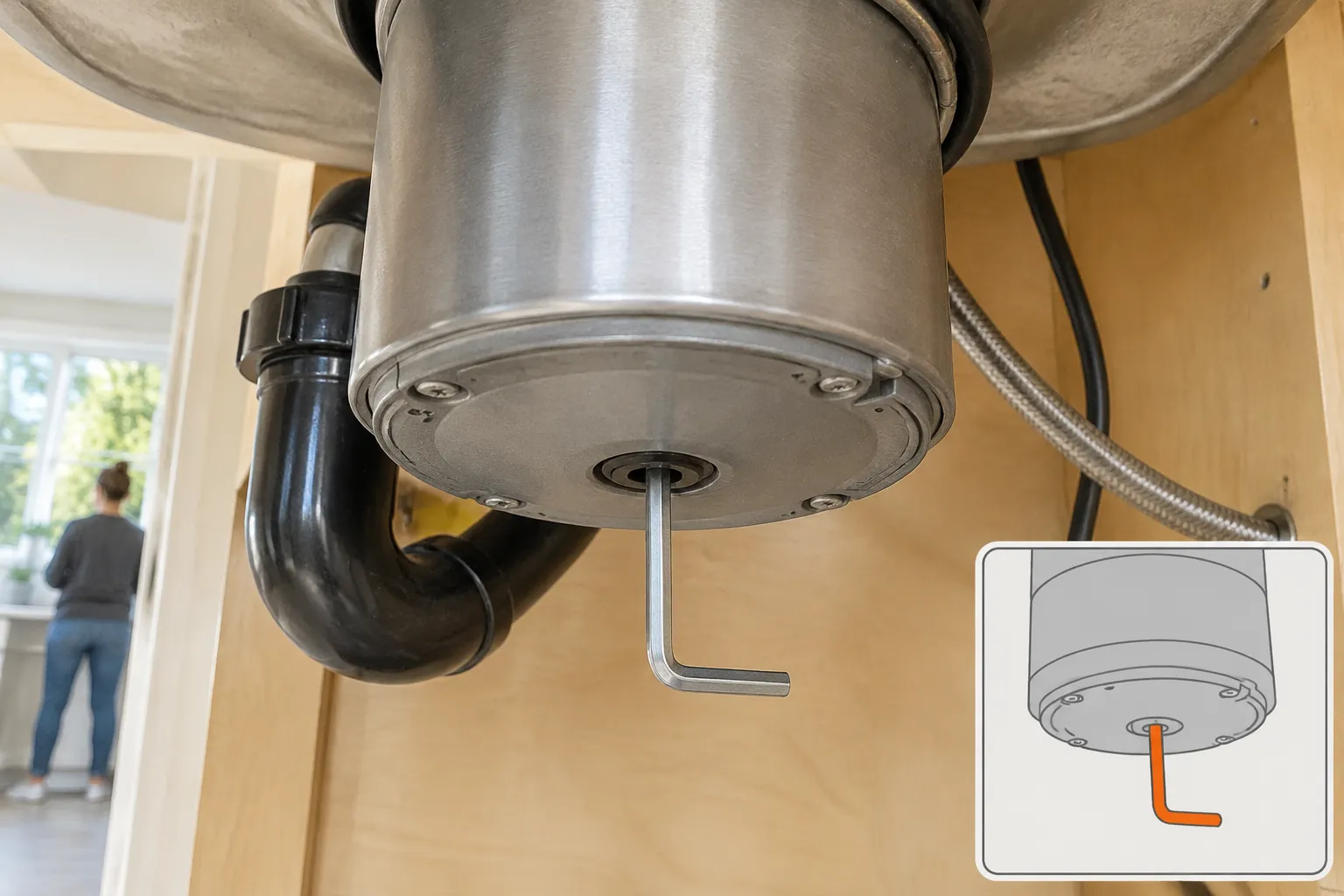
To repair a garbage disposal, switch off the power, turn the blades free with a 1/4 inch hex key in the socket under the unit, remove whatever jammed it, wait a few minutes for the motor to cool, then press the red reset button. That fixes most "dead" or humming disposals. If it still fails, leaks or trips the breaker, the next step is a garbage disposal repair plumber. This guide covers jams, clogs, leaks and noise, plus the limits of what is safe to try.
Before you start: how do you make a garbage disposal safe to work on?
Turn the wall switch off, then switch off the breaker or unplug the unit. Never put your hand into the chamber, even with the power off. Use tongs, pliers or a wooden spoon handle for anything you can see. Wear glasses if you will be leaning over the sink.
A few more habits that prevent injuries:
- Cut power at the source. A wall switch can be bumped. A breaker or unplugged cord cannot. Most under-sink disposals plug into an outlet in the cabinet; some are hardwired and need the breaker.
- Use a light, not a match. A phone flashlight is fine. Do not use anything with a flame near the sink cabinet.
- Wait if it just stopped. InSinkErator's own guidance for its units says to let the disposer cool for 3 to 5 minutes after it stops before you press the reset button. Do not press the button with a tool.
- Know your tools. A 1/4 inch hex key (Allen key) is the right size for most InSinkErator and Moen-type units. Many units ship with a small wrench. A broom handle works to turn the blades in an emergency.
If you smell burning, see smoke or sparks, or the unit is wet around the wiring, leave it off at the breaker and call a plumber or an electrician.
How do you fix a jammed garbage disposal?
A jam shows up as a hum with no spinning, or a click when you flip the switch. Fix it by turning the flywheel by hand: with power off, put a 1/4 inch hex key into the socket in the center of the underside, work it back and forth until it turns a full circle, then pull out the object and press reset.
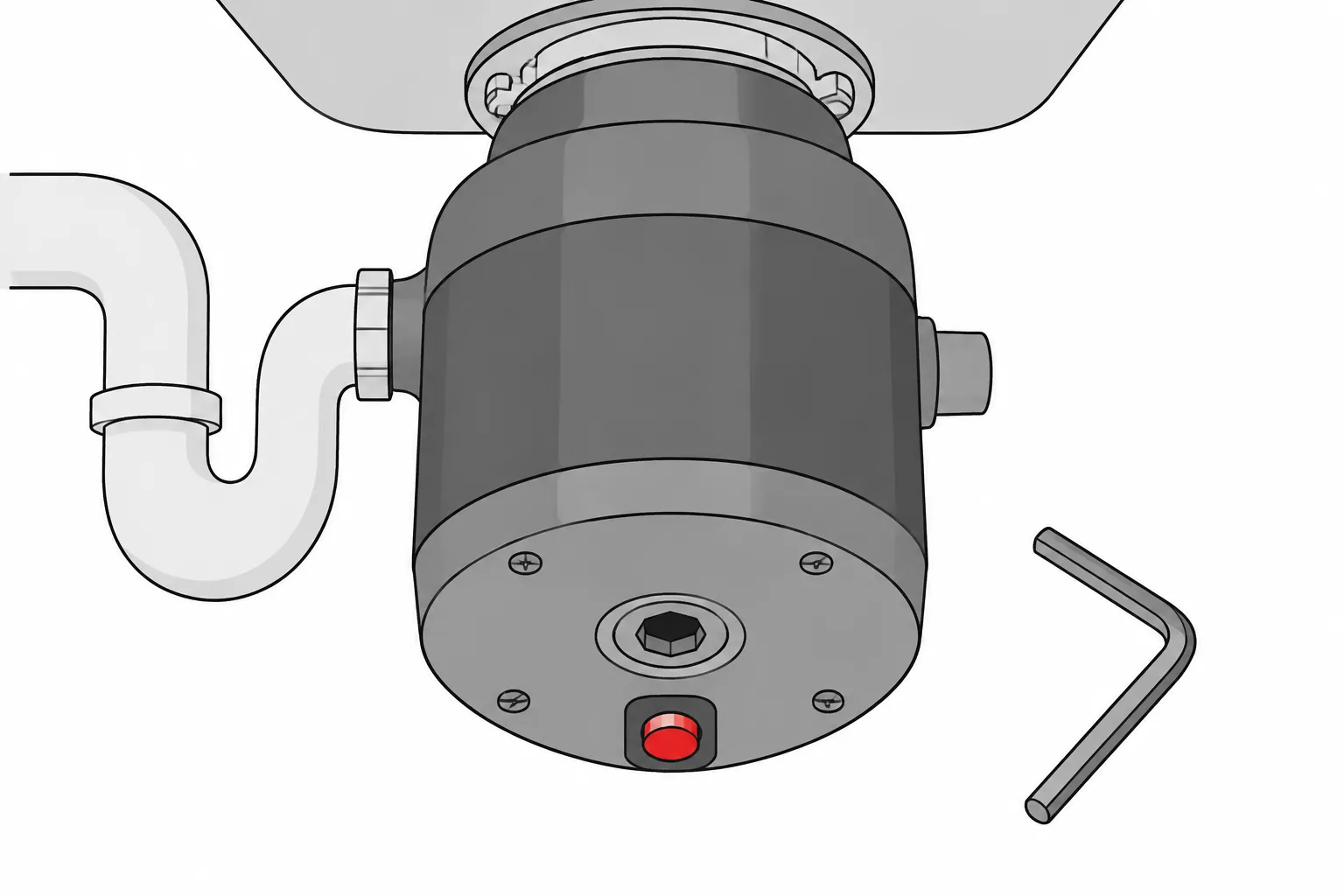
The steps, in order:
- Switch off the wall switch and the breaker or unplug it.
- Look into the chamber with a light. Remove anything you can see with tongs. Common culprits are a bottle cap, a fruit pit, a spoon or glass.
- Get under the sink and find the hex socket on the bottom. Fit the key in and turn it back and forth. You may feel it grind, then free up.
- Wait a few minutes if the unit just stopped running.
- Press the red reset button on the bottom or side. It should click and stay in.
- Restore power, run a steady stream of cold water, and switch it on.
If the reset button pops out again straight away, the motor has not cooled, something is still stuck, or an internal fault has tripped it. Repeat the cycle once. If it trips a second time, stop. Repeated tripping can overheat the motor, and a burnt-out unit is usually a replacement, not a repair.
What about a jam that will not free with the hex key?
If the key will not turn the flywheel at all, a hard object may be wedged between the impellers and the shredder ring, or the bearings have seized. Do not force the key hard or use a pipe over the handle, which can break the socket. This is the point to ask a specialist, particularly if the unit is more than about 10 years old.
How do you unclog a garbage disposal drain?
A clog shows up as water that rises in the sink or backs into the dishwasher. The unit may run fine. Run the disposal with cold water, check the trap and the pipe beyond it, and clear what you find. Do not pour drain chemicals into a disposal: they sit in the unit and can damage seals and your skin.
What to try, from least to most work:
- Hot water and dish soap. Run the disposal with cold water for 30 seconds, then flush with hot tap water to push loosened grease down.
- A sink plunger. Plunge with the disposal off. Block the second sink drain and the dishwasher line, which are the usual leak paths. A cup plunger that seals fully over the drain does the job.
- Clear the trap. Put a bucket under the P-trap, loosen the slip nuts by hand or with pliers, and tip out the contents. Check the short pipe into the wall for packed food.
- Check the dishwasher knockout. On a new disposal, a small plug inside the dishwasher inlet may never have been removed, which stops the dishwasher draining. This is a common installation slip.
A clog that comes back, or one that affects other sinks and the shower, is further down the line. At that point it is drain cleaning, not disposal repair. See sink drain cleaning for what a clear involves, or professional drain cleaning for a main line.
Why is my garbage disposal leaking, and can I fix it?
First find where the water appears. A leak at the top is usually a loose sink flange or a worn gasket. A leak from the side is often the dishwasher hose clamp or a drain pipe connection. A leak from the bottom or the body seam means the unit has failed and needs replacing.
Dry everything with a towel, put a few sheets of dry paper under the unit, then run water and look again.
- Top: around the rim of the sink drain. The mounting ring may need tightening, or the plumber's putty and gasket have worn.
- Side: check the dishwasher hose clamp and the discharge pipe slip nut. Tightening a loose slip nut can fix it.
- Bottom, or from the reset button: the housing has failed. A body leak is not repairable.
A drip you cannot trace, or any leak near the wiring, needs a plumber. Water damage inside the cabinet grows slowly and the cost climbs.
What do strange noises and smells mean?
Grinding with nothing in the chamber means a loose or broken part, often a spoon or glass shard. Rattling is usually something small loose inside. A bad smell is nearly always food in the splash guard or drain, not the motor. Neither is an emergency.
Quick fixes to try:
- Smell. Scrub the underside of the rubber splash guard with a brush and dish soap. Run ice cubes and citrus peel through it with cold water. Check the trap if the smell is sewage-like.
- Humming at start up. It may be jammed, or the capacitor may be failing. If the flywheel turns freely by hand and it still hums, replacement is likely.
- Grinding or rattling. Look into the chamber with a light, and use tongs only.
When should you call a plumber business instead of repairing it yourself?
Call a local plumber when the unit leaks from the body, keeps tripping the reset or breaker, smells of burning, will not turn even after you free the flywheel, or is more than about 10 years old and failing again. Drain problems beyond the disposal also need a plumber.
A rule for thinking about cost: free a jam yourself, and pay for anything that needs wiring, a leak you cannot trace or a motor replacement. Fixr's garbage disposal guide lists $65 to $150 for a repair, depending on the fault. If the unit needs replacing, see what replacing a garbage disposal costs. For general call-out rates, see how much a plumber costs overall.
Hardwired units and anything involving the household electrical circuit are a job where California's contractor rules apply once the total reaches $1,000. A disposal swap sits well under that, but a plumber should still quote in writing.
When you are ready to compare prices, you can get quotes from local specialists. To see where the rest of the site can help, start from the home page.
Questions people ask
How long does a garbage disposal repair take?
A jam or reset fix takes 15 to 30 minutes if you do it yourself. A plumber visit usually runs 30 minutes to an hour for a repair and an hour or two for a full replacement. Clearing a clogged trap or drain adds time.
What should I ask before I hire someone to fix a garbage disposal?
Ask for the total price in writing, including the call-out fee. Ask whether repair or replacement is cheaper for your unit. Ask what comes with the work, such as parts warranty, and confirm they hold a California contractor license for the job.
Do I need to be home when a plumber repairs my disposal?
Usually, yes. The plumber needs the cabinet cleared and you should approve the price before they start. If you will be out, agree access and the price beforehand in writing.
Can I use a hex key on any garbage disposal?
Most residential disposals have a 1/4 inch hex socket on the underside, but not all. Some low-cost models have no socket, and you free the blades by inserting a wooden handle in the chamber from above with the power off. Check your model's manual or the label on the unit.
Why does my disposal hum and not spin?
The motor is powered but the blades cannot turn. Switch off the power, free the flywheel with the hex key and press reset. If it hums again, the motor or its capacitor may be failing, and replacement is likely cheaper than repair.
Can I pour drain cleaner into a garbage disposal?
It is better not to. Chemical drain cleaners sit around the unit, can damage seals and rubber parts and are a hazard if they splash back. Use a plunger, clear the trap, or call a plumber if the clog is below the disposal.
Sources used
Last changed