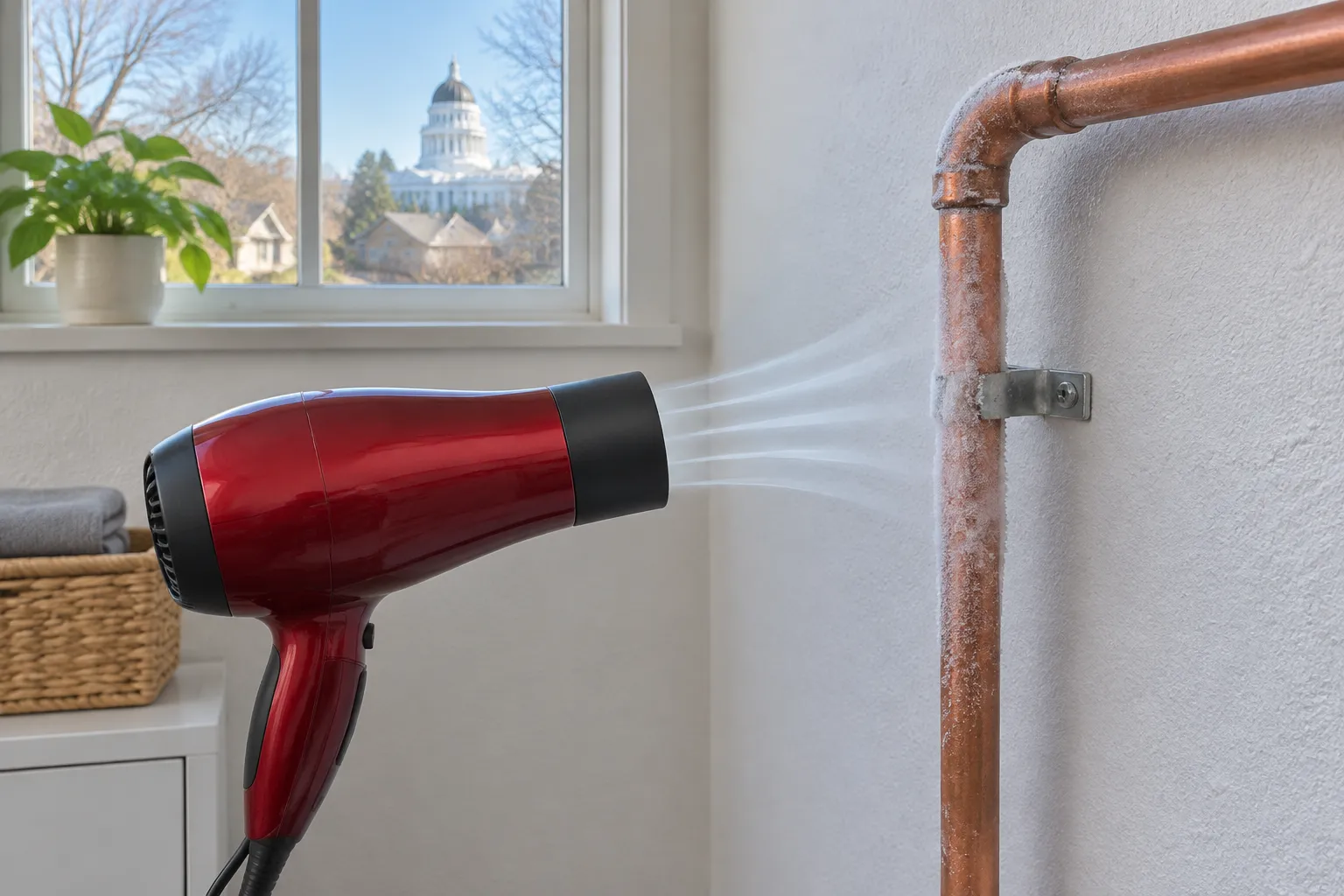
To unfreeze a water pipe, open the nearest faucet, find the frozen section, and warm it slowly with a hair dryer, a heating pad or warm towels, working from the faucet end back toward the ice. Never use a torch or open flame. If you see a crack or water appears, shut off the main valve and call a plumber. This is a rare problem here, as the plumbing guide home page and the frozen pipe overview explain, but a cold snap can still catch a crawl space or outdoor line.
How do you find the frozen section?
Start with the symptom. A faucet that gives no water or only a trickle, while others work, points to a frozen run. Look at pipes along exterior walls, in the crawl space, attic or garage, and on any outdoor line. Frost on the pipe, a bulge, or a section that feels very cold to the touch is the likely spot.
Check the whole house first. If every tap is dry, the problem may be at the main line, the meter or the street, and a thaw at a single pipe will not help. If only the kitchen sink is dry and its pipe runs along an outside wall, open the cabinet below and look. Use a flashlight, because crawl spaces and cabinet backs are dark. The article on how you know if your pipes are frozen goes through the signs in more detail.
What is the safest way to thaw a frozen pipe?
Open the faucet so melting water has somewhere to go, then apply gentle, even heat to the pipe, starting at the end nearest the tap. A hair dryer on a low setting, a heating pad wrapped around the pipe, or towels soaked in hot water all work. Keep applying heat until full water pressure returns. It can take from several minutes to an hour.
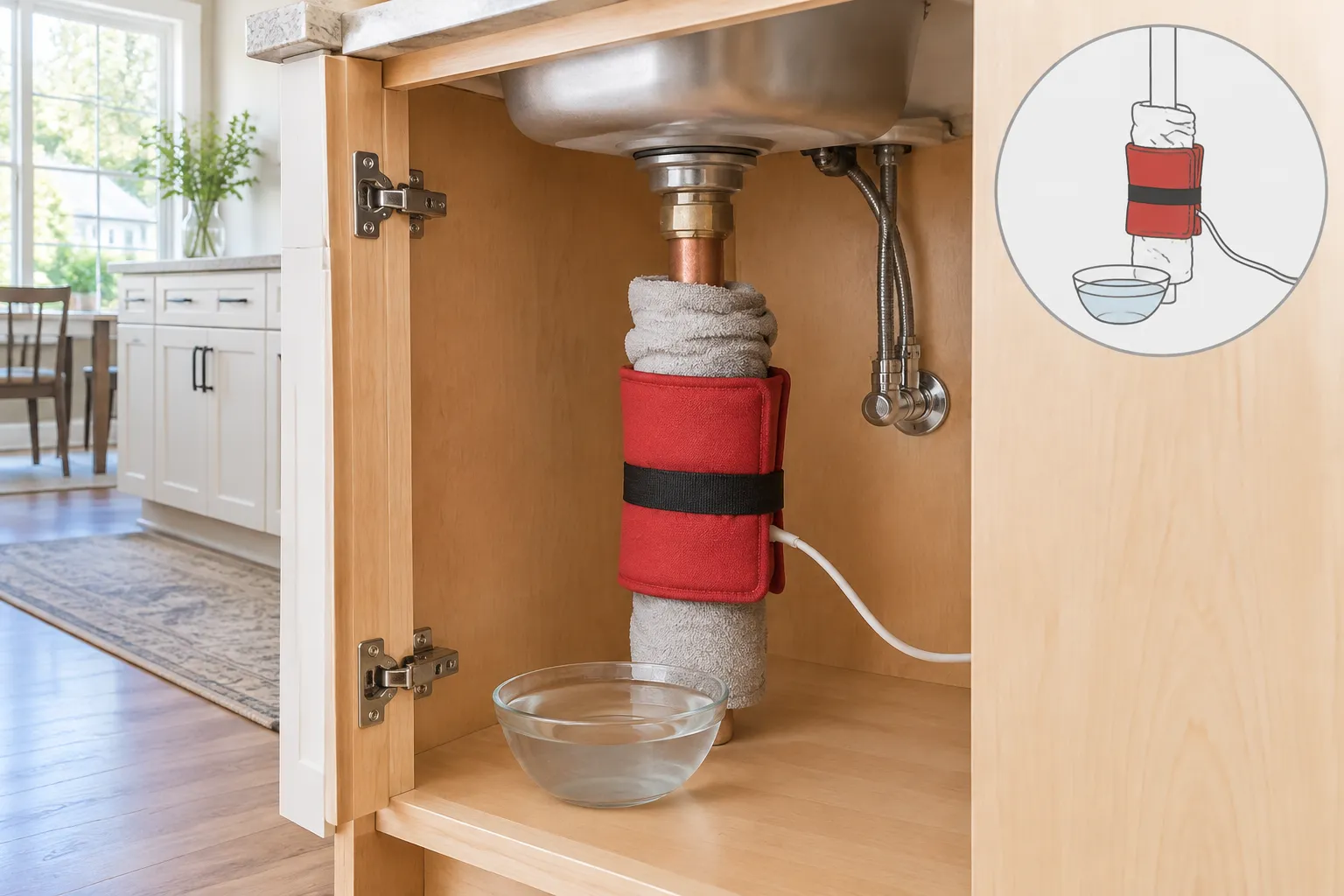
Step by step:
- Open the faucet, both hot and cold if it is a mixer, and leave it open. Moving water as the ice melts relieves pressure.
- Shut off the main water valve if you suspect a split. Do this before you start heating if you can see a crack.
- Warm the pipe from the faucet end toward the ice. Heating the far end first can trap steam and pressure.
- Keep the heat source moving and keep it away from anything flammable, and never leave it alone.
- Check for leaks along the pipe as water starts to flow. Turn the main off again if you see any.
- Once water runs freely, leave the tap running for a few minutes, then close it and check the pipe and its joints again.
Warming the room also helps. Open the cabinet doors so warm air reaches the pipe, and turn up the heat. In a crawl space, a gentle fan heater placed well away from insulation and set on a stable surface may help, but only while you are there watching it.
What should you never use to thaw pipes?
Never use a propane torch, a blowtorch, a camp stove or any open flame. Do not use a kerosene or propane heater inside a crawl space or enclosed area, and do not pour boiling water over a pipe. Flames can ignite insulation and wood, scorch plastic and copper joints, and cause carbon monoxide risk. They are a common cause of house fires during thaws.
Other mistakes:
- Heating a split pipe. If a section is cracked, heat releases the water through the crack. Turn off the main first.
- Using high heat on plastic. PEX, CPVC and PVC soften and deform. Use warm air, not a heat gun on full power.
- Leaving the tap closed. Without an open tap, pressure from melting ice can force a weak spot to give.
- Walking away. A thawed pipe with a hidden split can flood a house within minutes.
If you are unsure whether the pipe is copper, galvanized steel or plastic, assume it is the more delicate material and keep the heat low.
What if water leaks after the pipe thaws?
Shut the main valve at once, open a tap to drain the line and call a plumber. A pipe that has frozen can split, and the split often shows only after the ice melts. Do not tape it and hope. A temporary clamp or wrap can slow it, but the weak section extends beyond the visible crack. See what to do about a burst pipe for the first-ten-minutes checklist and typical repair costs.
If the leak is from a plastic pipe outside, such as a sprinkler line, hose bib supply or drip line, the fix is usually a short section replaced with a coupling or a new fitting. Turn off the irrigation valve first. Because outdoor lines are often shallow and light-gauge, they split easily in a freeze and often need only a small repair.
Can you legally do your own plumbing in California?
Thawing a pipe is not plumbing work that needs a contractor or permit. Repairing or replacing piping is different. California requires a contractor with the right California license for plumbing jobs of $1,000 or more, or for any job that needs a permit. The City of Sacramento lists plumbing repairs among permit work. Homeowners may do some work on their own home, but permits and inspections still apply.
In plain terms: you can thaw your own pipe, clamp a leak temporarily and replace a washer or faucet. A new run of pipe, a relocated line, anything involving a gas line or a water heater is a job to ask the building department about before you start. The city or county building division can tell you what needs a permit.
How do you Hire the right plumber if the pipe is damaged?
Hire someone who holds an active California plumbing contractor license (classification C-36) and ask for the number in writing. Check it with the Contractors State License Board. A plumber with experience in repairs inside walls and crawl spaces has the expertise you want. Ask for a written price, who pulls any permit, and who patches the wall afterward.
The quote page lets you ask local specialists for prices. How hourly charges stack up is covered in the guide to plumber rates per hour. For a leak you cannot find, see the guide on leak detection cost.
How do you stop it happening again?
Insulate exposed pipes with foam sleeves, cover outdoor faucets, disconnect hoses before winter and let a tap drip on the one or two nights a year that forecast hard cold. Keep the heat on if you travel. Plastic pipe tolerates cold better than copper, so a repipe is another option, though in Sacramento it is rarely justified by freezing alone.
On outside plastic pipe leaks, the usual fixes are a repair coupling, a fresh section and a pressure test, not a patch. If the same line keeps failing, ask whether it is too shallow, whether pressure is too high or whether age is the real cause.
How often do house water pipes need replacing?
It depends on the material, water chemistry and installation quality, and galvanized steel rusts from the inside and restricts flow over time. Replace pipes when they leak repeatedly, show green or brown staining, or when water pressure falls. Frozen pipes alone rarely decide it.
Polybutylene, a plastic once used for home water supply lines, has a record of failure at fittings, and many owners replace it before it leaks. If your house has it, ask a plumber about a whole house repipe.
Questions people ask
How long does it take to unfreeze a pipe?
Between ten minutes and an hour for a short exposed section, longer for one inside a wall. Do not hurry it with higher heat. If the pipe is in a wall or crawl space you cannot reach, or if nothing changes after an hour, stop and call a plumber rather than risk a split or a fire.
Can I use a hair dryer or space heater on frozen pipes?
A hair dryer is the safest common tool, used on low and kept moving. A small electric space heater can warm a room or crawl space, but keep it clear of insulation and anything combustible, plug it into a safe outlet and never leave it unattended. Do not use fuel-burning heaters in enclosed spaces.
What should I ask before I hire someone to thaw pipes?
Ask for their license number, whether the visit price is fixed or hourly, how they will thaw the pipe without damaging it, and what happens if the pipe has split. Ask whether any repair needs a permit and who arranges the inspection. Get the answers in writing before work starts.
Do I need to be home when a plumber thaws a pipe?
Someone should be there at the start to show the shutoff and the frozen section. After that you can often step away if access is clear and you can be reached. If the work is in a crawl space or wall, agree in advance how the plumber will show you the result.
Sources used
Last changed