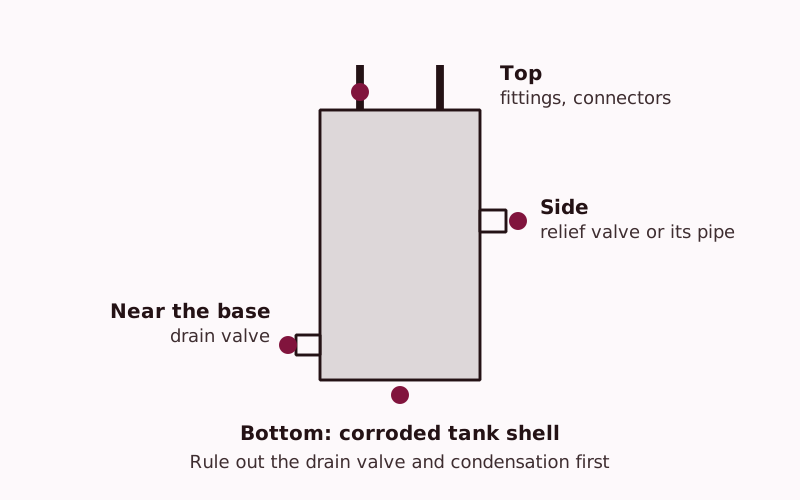
If your water heater is leaking, shut off its power or gas, close the cold water valve above it, and find out where the water is coming from. A drip from a pipe fitting or the relief valve is often a modest repair. Water seeping from the bottom of the tank usually means the tank itself has failed, and a new unit is the answer. The page on water heater repair and replacement covers the wider picture. This one is about the leak.
What should I do first when my water heater is leaking?
Switch off the heat source, close the cold water supply valve on the pipe above the tank, and keep people and pets away from the puddle. For an electric unit, turn off its breaker. For a gas unit, turn the gas control dial to off. Then mop up and note where the water appears.
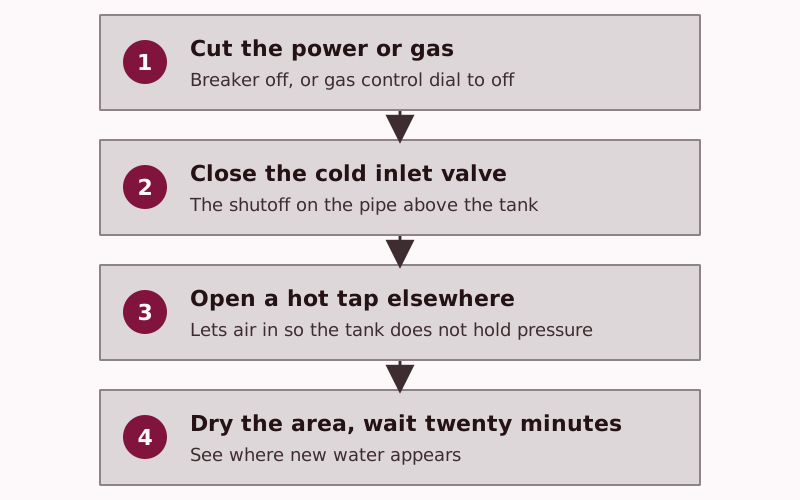
Do these steps in order:
- Cut the power or gas. An electric element heating in a drained tank burns out in minutes. A gas burner firing under a leaking tank wastes fuel and can scorch the floor.
- Close the cold inlet valve. It is the shutoff on the pipe that enters the top of the tank, usually a lever or round handle.
- Open a hot tap elsewhere. This lets air in so the tank does not hold pressure on the leak.
- Dry the area and wait twenty minutes. A fresh paper towel placed under each pipe, valve and the base shows you where new water appears.
If you smell gas, do not stay to investigate. Leave the house and call 911, then the PG&E gas emergency line. Gas work in California is regulated, so the repair is never a do-it-yourself job.
Is a water heater leaking dangerous?
A slow drip is usually a property-damage risk, not a safety risk. Three situations are more serious: water near a gas appliance with a gas smell, water pooling around an electric unit that is still powered, and a relief valve discharging scalding water. Treat those as urgent and keep clear.
Water on the floor weakens subfloor, drywall and cabinet bases quickly, and mold can follow within a couple of days in a closed utility closet or garage. Hot water from the relief valve or its pipe can scald, so never put your hand under it. A tank that has begun to leak from the shell rarely recovers, and it can fail suddenly and release the full volume, which is 40 to 50 gallons in a typical home. If the heater sits in an attic or above a finished room, shut the water off sooner rather than later.
Where is the leak coming from, and what does each spot mean?
The location points to the cause. Water at the top is usually a fitting. Water at the side is usually the relief valve or its pipe. Water at the bottom is often the tank. Water at the base can also be the drain valve, so check it before you decide the tank is finished.
| Where you see water | Likely cause | Typical fix |
|---|---|---|
| Top of tank, around inlet and outlet pipes | Loose or corroded fittings, failing flex connectors | Tighten, replace connectors |
| Side, from the relief valve or its pipe | Valve worn or tank pressure too high | Replace valve, check for thermal expansion |
| Front, near the drain valve | Worn drain valve or seat | Replace drain valve |
| Electric unit, behind the access panel | Failed element gasket or condensation | Replace gasket or element |
| Bottom of the tank, dripping from underneath | Corroded tank shell | Replace the water heater |
| Gas unit, water in the burner area | Tank leak running down, or condensation on a high-efficiency model | Confirm source, likely replace |
Condensation is worth ruling out. A cold tank filling after a heavy hot-water use can sweat on a humid day, and some high-efficiency gas units release small amounts of condensate by design. Condensation stops when the tank warms. A leak keeps going.
Why is my water heater leaking from the bottom?
Water at the bottom has four possible sources: the drain valve, a leaking pipe above that runs down the tank, condensation, or a rusted-through tank. If you have ruled out the first three and water still collects under the unit, the steel tank has corroded and needs replacing.
Inside every tank an anode rod, usually magnesium or aluminum, is meant to corrode first so the steel does not. Once the rod is used up, the lining and then the steel go. Hard water, a high temperature setting and sediment all speed this up. A tank that leaks from the shell cannot be patched in any lasting way. Sealants and epoxy products sold for the purpose are a short delay at best, and they leave the tank liable to fail without warning.
Before you condemn the unit, tighten the drain valve cap and dry the area. If you see water running down from a connector above, the tank may be fine.
Why is my water heater pressure valve leaking?
The temperature and pressure relief valve opens to release water when pressure or heat inside the tank climbs too high. It may drip for two reasons: the valve is worn and no longer seats, or your plumbing is building pressure it has nowhere to go, a condition called thermal expansion. A plumber can tell which in a short visit.
Never cap or plug the valve or its discharge pipe. It is the last safety device on the tank. Our page on replacing a water heater pressure relief valve covers the part, the discharge pipe and the cost. If the valve drips only while the heater is heating, thermal expansion is the likelier cause, and a small expansion tank fitted on the cold line often solves it. If the valve runs constantly and the water is very hot, turn the heater off and call a plumber the same day.
How much does a leaking water heater cost to fix?
Fixr's water heater repair guide (updated August 2025) lists $100 to $250 to replace a relief valve and $100 to $200 to replace a drain valve. A failed tank means replacement, and This Old House's water heater cost guide (updated June 2026) puts an installed tank water heater at $1,200 to $2,300. Sacramento prices vary. A local specialist quotes the real price after seeing the unit.
| Job | Typical range |
|---|---|
| Replace relief valve | $100 to $250 |
| Replace drain valve | $100 to $200 |
| Add expansion tank | $150 to $400 (Fixr, 40-gallon guide) |
| Replace the water heater (tank, installed) | $1,200 to $2,300 (This Old House) |
Prices rise when the heater sits in an attic, when the gas line, vent or electrical circuit needs work, or when it must be brought up to current code. Our guide to water heater replacement cost breaks the larger job down.
Does a leaking water heater need a permit in Sacramento?
Replacing a water heater generally needs a permit in Sacramento, and the plumber normally pulls it. The City lists water heater permits and fees on its building pages, and the plumber arranges the inspection. Repairs to a valve or fitting usually do not. Ask the plumber who will handle the permit before work starts.
California also requires new and replacement water heaters to be braced, anchored or strapped against earthquake movement, under Health and Safety Code section 19211. A replacement should arrive with straps fitted. Legal work: California requires a contractor with the right California license for jobs of $1,000 or more in labor and materials, so a full replacement falls under that rule. You can check any contractor's license on the Contractors State License Board site.
When can I wait, and when is it an emergency?
Wait a day only if the leak is a slow drip from a fitting, the water is shut off at the cold inlet, and the floor is protected. Treat it as an emergency when water pools quickly, the unit is in an attic or above a finished ceiling, or you smell gas. See our notes on emergency water heater repair if you need a same-day visit.
Living with a leaking heater for weeks is expensive. Water damage costs more than most repairs, and a rusted tank keeps getting worse. If you need hot water meanwhile, a short-term fix is to keep the tank off and the cold valve closed while you wait. To compare options on a replacement, see tank versus tankless water heaters, or return to the homepage for the full list of plumbing guides.
Questions people ask
Can you still use water if the water heater is not working?
Yes. Cold water to your taps is separate from the heater, so closing the inlet valve on the heater does not shut off the house. Keep the heater's own inlet closed if it is leaking. Hot taps will give cold water until it is fixed. Do not run a leaking electric heater with the power on.
How long does water heater leaking take to fix?
A valve, connector or drain valve repair is usually a one-visit job of an hour or two. A tank replacement typically takes half a day, longer if the gas line, vent or wiring needs work. Permit inspection may be a separate visit, depending on how the plumber schedules it.
Is a slow water heater leak worth repairing?
It depends on where it is. A fitting or valve leak is cheap to repair. A leak from the tank is not repairable, and a unit past about 10 to 12 years is better replaced than patched. Ask the specialist to say which part is leaking before you approve a repair.
What should I ask before I hire someone for water heater leaking?
Ask whether the quote covers the permit, haul-away of the old tank, new earthquake straps, and any code upgrades such as a pan or expansion tank. Ask for the contractor's CSLB license number and check it on the board's site. Ask what the old and new unit's warranty covers.
Does homeowners insurance cover a leaking water heater?
Policies differ. Many cover sudden water damage from a burst or failed tank but not the heater itself, and exclude slow leaks or wear. Take dated photos, keep the old unit if asked, and read your policy or call your insurer before you throw anything away.
Sources used
Last changed